"Ageing in Place" is growing older
without having to move.
According to the Journal of Housing for
the Elderly, it is not having to move from
one's present residence in order to secure
necessary support services in response to changing need.
Some 70% of seniors spend the rest
of their life in the place where they
celebrated their 65th birthday.
We are using the term "Ageing in Place" in reference to living
where you have lived for many years, or to living in a non-healthcare
environment, and using products, services and conveniences to allow or
enable you to not have to move as circumstances change. More recently
"Ageing in Place" is a term used in marketing by those in the rapidly evolving
senior housing industry. CCRCs, (Continuing Care Retirement Communities),
by definition offer the chance to age in place, but first you must move
to their community to "start ageing". Multi-level campuses market "Independent
Living, Assisted Living and perhaps Alzheimer's care and Skilled Nursing
in one location, and claim to offer the opportunity to "age in place",
but again you must move there first. In many cases you must also move
from one wing of the campus to another to receive the increased services.
Here we address issues and needs related to "Ageing in Place", without
first relocating.
NORC is a community or neighborhood where residents remain
for years, and age as neighbors, a NORC or Naturally Occurring Retirement
Community develops. NORC may refer to a specific apartment building, or
a street of old single family homes. Residents would just have stayed
in their home or apartment for many years, and evolved into a senior community.
It is possible to band together and develop, or seek help
to develop, access to services to aid those needing assistance, to retain
the highest quality of life as they age.
Some 27% of seniors live in a NORC.
Fair housing laws provide for a complex with 80% of its
residents over 55, to become officially age restricted.
For many years the law required an age restricted community
to offer significant amenities and services if it was age restricted.
That is no longer the case, but to compete, and attract residents, we
still see most age restricted communities offering amenities and services
to serve their residents.
A significant concern as people grow older is that they may have to
leave their home. This would mean leaving behind a comfortable setting
and many memories. In addition a certain amount of control is lost when
one leaves their home. This "control" provides the underpinning
to our feelings of dignity, quality of life and independence. One's home
is a strong element in their sense of security.
Most American seniors desire to stay in their homes for the rest of their
lives. In fact an AARP survey found this number to be greater than 80%
of seniors. This "stay at home" approach is also know as "Ageing in Place" Several reasons are cited for this strong Ageing in Place
preference. These include:
Comfortable Environs
Independent Feeling
Convenient to Services
Familiarity
Safe and Secure
Close to Family
"Ageing in Place" successfully requires planning. To accommodate
physical, mental, and psychological changes that may accompany ageing,
physical changes should be made in your home.
Contrary to popular belief, most American seniors live independently
while maintaining strong relationships with family and friends. Their
personalities remain relatively stable throughout their lives. Depression
occurs less in uninstitutionalized seniors than among young adults.
Normal age related changes do occur. These may include:
Hearing impairment
Weakening vision,
Osteoporosis.
Increased likelihood of arthritis, diabetes, heart disease, and hypertension,
Mental process changes
speed at which information is processed
speed of responding to changes in the environment
long term memory declines
word finding ability declines
Visual impairments
decreased reading speed
seeing in dim light
reading fine print
sensing changes in the environment
These changes may lead to difficulties in interacting with one's living
environment. These include:
However some functions tend to remain the same with advancing age. While
seniors tend to process new information slower, daily social and occupational
functioning ability remains stable. Most language related skills also
tend to remain stable with age. Most notably, creativity and wisdom continue
at strong levels.
In addition to physical changes, seniors experience social changes that
may be disruptive. These include: isolation from family and friends, loss
of peers children living far away and hanging neighborhood
The ageing process is blamed for many problems seniors may encounter
with daily activities. However quite often it is the home itself that
caused the difficulties. Most residential housing is geared to young healthy
adults. Builders do not take into account age-related conditions such
as reduced mobility or limited range of reach. Hence, most dwellings do
not support the physical and sensory changes that older adults encounter
as they age. What appear to be insignificant home features can have significant
effect: for a person with even minor ageing issues.
Many seniors avoid home modifications and helpful technology items that
are designed for people with disabilities. This is caused by these products
having an industrial appearance. No one wants to have their home look
like a hospital. Consumer demand and computer technology have pushed institutional
products to be redesigned to be more acceptable in the home. Some of these
include:
Chairs designed for easier in and out
Enhanced high and low frequency tones for doorbells and telephones
Grab bars and hand rails with decorator colors
Hospital type beds with wooden headboards and footboards
Items that are easier for arthritic hands to handle,
Larger print for declining eyesight
On/off buttons with color contrasts
Walkers in bright hues
The National Center for Injury Prevention and Control states that falls
are the number one cause of home injury, and studies suggest that a significant
proportion of all falls are due to environmental factors
The three leading causes of home injuries, according to the National Center
for Injury Prevention and Control, are: falls, burns and poisoning. Seniors
are especially susceptible to these types of injuries. Most falls are
caused by environmental factors such as a home not truly suited for a
person with elderly issues. Burns are caused primarily from fires. Older
adults are killed in home fires at twice the rate of society as a whole
(National Association of Home Builders (NAHB), 1990 Poisoning is mostly
caused by medicine non-compliance: older adults are six times more likely
than other age groups to suffer adverse medical reactions (Alliance for
ageing Research, 1998).
One of the bigger challenges is to identify safety issues that may be
unique to an individual based on their particular ageing status and conditions.
While research via books and the internet can help focus on such issues
the use of a good checklist in assessing the home environment is helpful.
It is important to do a thorough assessment of the home to assure that
it can properly handle an elderly or infirm individual. The following
table provides a summary of items to review and or consider.
Senior Difficulty
Possible Remedy
Balance and Coordination Problems
Bath seat in the tub or shower.
Bath tub with transfer bench
Counters edges are rounded
Grab bars near the bath and toilet.
Handrails extend beyond the top and bottom of the stairs.
No stairs to bedroom or bathroom.
Phone in the bathroom.
Stairway handrails on both sides.
Walk-in shower with pull-down seat.
Hearing Impairment
Dishwasher is ultra-quiet to reduce background noise.
Increased the volume on phones.
Smoke detectors have strobe lights.
Limited Reach
Cabinet shelves are no more than 10 inches deep.
Closet organizer that to reach belongings.
Closet rods pull down to a comfortable level.
Clothes washer and dryer are front-loading
Cooktop has easy-to-reach controls at the front.
Electrical outlets are 27 inches above the floor.
Hand-held shower in bathroom.
Kitchen and closets have pull-down shelving.
Lazy Susan to reach things stored on deep shelves.
Microwave oven is no higher than 48 inches above the floor.
Oven doors swing to the side.
Pull-out shelves in the kitchen.
Side-by-side refrigerator.
Sink controls are on the side
Upper kitchen cabinets are 48 inches from the floor.
Limited Vision
Edge of counters a different color than the top.
Edge of each step is a color that stands out.
Increased wattage of light bulbs.
Lights are in all closets.
Outside walkways, stairs, and entrances are all well-lit.
Stairs are well lit.
Steps are a different color than the surrounding area.
Stove controls are clearly marked and easy to see.
Stove has big numbers that can seen from across the room.
Stove uses different colors to tell which parts are hot.
Under-the-cabinet lights are over the kitchen
counter.
Poor Hand and Arm Strength
Automatic garage door opener.
Cabinets and drawers have D-shape handles.
Countertops smooth so heavy pans can slide across them.
Doors have lever handles.
Garbage disposal to reduce trash
Heat-resistant counter near microwave oven.
Push-button controls are on appliances.
Rocker light switches
Sinks with lever faucet handles.
Special hardware makes to make drawers slide easily.
Spray hose to fill pots on the stove
Trash compactor to minimize trash bags.
Dishwasher is eight inches from the floor.
Trouble Bending
Elevated toilet or toilet seat.
Lower kitchen cabinets six inches above the floor.
Sink no more than 6? inches deep.
Carpet is low pile and a firm pad.
Clutter and electric cords are out of pathways
Countertop thatcan be used while sitting
Doors are wide enough for a walker to get through.
Trouble Walking and Climbing Stairs
Driveway is smooth, but not slippery.
Floors are smooth and slip-resistant.
Knee space under sinks, can sit while washing.
Knee space under the stove, can sit while cooking.
No area rugs.
Ramp to front door with handrails on both sides.
Stairs have slip-resistant surface.
The threshold on my door is no higher than 1/4 inch.
Uses a Wheelchair
"Walk-in" closet wide enough for wheelchair.
Appliances have controls at the front
Cabinet shelves no more than 10 inches deep.
Can use my counter while sitting in a wheelchair.
Can wheel from car to the front door and then inside.
Can wheel to bedroom, bathroom, and kitchen.
Uses a Wheelchair
Closet organizer to help reach all belongings.
Closet rods pull down to a comfortable level.
Clutter and electric cords are out of pathways.
Doors and hallways are wide enough for a wheelchair.
Electrical outlets are 27 inches above the floor.
Enough floor space near doors to move wheelchair.
Floors are smooth; carpet has a low pile and a firm pad.
Hand-held shower.
Heat-resistant counter near my microwave oven.
Uses a Wheelchair
Kitchen ad closets have pull-down shelving.
Knee space under all sinks.
Knee space under the stove.
Lazy Susan to reach things stored on deep shelves.
Microwave oven is no higher than 48 inches above the floor.
Oven doors swing to the side.
Pull-out shelves in the kitchen.
Ramp has an edging.
Ramp to my front door with landings at bottom and top.
Successful "Ageing in Place" requires identifying
and correcting any safety pitfalls. These may include many things some
of which were noted in the table above. However, preventing falls must
be a major focus to assure a safe environment. Further discussion of safety
related items can be found here.
Senior Low Vision
Over one million Americans aged 40 and over are currently
blind and an additional 2.4 million are visually impaired.
The leading causes of vision impairment (low vision) and blindness in
the U.S. are diabetic retinopathy, age-related macular degeneration, cataract,
and glaucoma. -- DIABETIC RETINOPATHY is a common complication of diabetes. Retinal
blood vessels can break down, leak, or become blocked, affecting and impairing
vision over time. Nearly half of all people with diabetes will develop
some degree of diabetic retinopathy during their lifetime, and risk increases
with age and duration of diabetes. People with diabetes are encouraged
to seek annual dilated eye exams. Currently, laser surgery and a procedure
called a vitrectomy are highly effective in treating diabetic retinopathy.
Research into pharmaceutical treatment options is continuing. -- AGE-RELATED MACULAR DEGENERATIONis a condition that primarily
affects the part of the retina responsible for sharp central vision. There
are two forms of AMD -- dry AMD and wet AMD. Because AMD often damages
central vision, it is the most common cause of legal blindness and vision
impairment in older Americans (AMD rarely affects those under the age
of 60). While there is no generally accepted treatment for dry AMD, laser
therapies to destroy leaking blood vessels can help reduce the risk of
advancing vision loss in many cases of wet AMD. Research sponsored by
the National Eye Institute has recently shown that a combination of zinc,
vitamins C and E, and beta-carotene may also reduce the risk of advanced
AMD by 25 percent. -- CATARACTis a clouding of the eye's naturally clear lens. Most
cataracts appear with advancing age. Scientists are unsure what causes
cataract. The most important factor is increasing age, but there are additional
factors, including smoking, diabetes, and excessive exposure to sunlight.
Cataract is the leading cause of blindness in the world, and affects nearly
20.5 million Americans age 40 and older. By age 80, more than half of
all Americans develop cataract. Cataract is sometimes considered a conquered
disease because surgical treatment that can eliminate vision loss due
to the disease is widely available. However, cataract still accounts for
a significant amount of vision impairment in the U.S., particularly among
people age 65 and over who may have difficulty accessing appropriate eye
care. -- GLAUCOMA is a disease that causes gradual damage to the optic
nerve, that carries visual information fromthe eye to the brain. The loss
of vision is not experienced until a significant amount of nerve damage
has occurred. For this reason, as many as half of all people with glaucoma
are unaware of their disease. About 2.2 million Americans age 40 and older
have been diagnosed with glaucoma, and another two million do not know
they have it. Most cases of glaucoma can be controlled and vision loss
slowed or halted by timely diagnosis and treatment. However, any vision
lost to glaucoma cannot be restored.
Those affected by low vision often become depressed, are prone to falls
and resultant injuries, and many are socially isolated. There are several
things that can be done to assist those with low vision.
Several tips for handling low vision situations can be found
here.
Senior Fire Safety.
The physical and mental impairments that tend to accompany
ageing tend to reduce older adults' reaction times and place them at a
higher risk for causing fires, and thus at a higher risk of fire injury.
Disabilities present additional fire risks and concerns for the elderly.
Many Medicare enrollees re unable to complete at least some of the normal
activities of daily living (ADL) necessary for a degree of self-sufficiency.
Economic and social concerns also contribute to the fire risk for older
adults. Most live on fixed incomes and many live in poverty. Hence, they
may be unable to afford to make necessary home improvements that could
substantially reduce their risk of fire.
Several tips for addressing senior fire safety can be found here.
There are a number of items to consider when remodeling your home. You
may wish to consult a professional early in your evaluation process. No
one is going to make all of the modifications, but be wise regarding those
you focus on. i.e. if you already know your eyesight is failing, focus
on modifications that benefit poor, or poorer eyesight the most. If you
have arthritis that impairs mobility, focus on modifications that cater
to your mobility limitations.
General
Adapt lower floor of home for possible one
level living
Increased incandescent general and specific
task lighting
Easy garage or parking access
At least one entry is without steps
Doorways 36" wide with off-set hinges on doors
Levered door handles instead of knobs
Electrical outlets at 18 inches instead of
12
Easy to open or lock patio doors and screens
Light switches at 42" instead of 48
Adjustable controls on light switches
Luminous switches in bedrooms, baths and hallways
Strobe light or vibrator-assisted smoke and
burglar alarms
Lower window sills especially for windows
on the street
Programmable thermostats for heating and cooling
Contrast colors between floor and walls
Color borders around floor and counter-top
edges
Non skid flooring
Matte finish paint, flooring and counter-tops
Non-glare glass on art work
Peep hole at a low height
Incorporation of emergency response system
installed or wearable
Bathroom
Lever faucets and faucet mixers with anti-scald
valves
Temperature controlled shower and tub fixtures
Stall shower with a low threshold and shower
seat
Grab bars at back and sides of shower, tub
and toilet or wall reinforcement for later installation
Bathrooms with turn around and transfer space
for walker or wheelchair (36" by 36")
Higher bathroom counters
Telephone jack
Installation of medical response device
Kitchen
Kitchen cabinets with pull-out shelves and
lazy susans
Easy to grasp cabinet knobs or pulls
Task lighting under counters
Cooktop with front controls
Side by side refrigerator
Adjustable upper shelves and pull out lower
shelves
Variety in kitchen counter height - some as
low as table height (30 inches)
Gas sensor near gas cooking, water heater
and gas furnace
To "age in place" one should be aware of community help and services
available to deal with increasing frailty or age related problems. They
may also be needed in the event of illness.
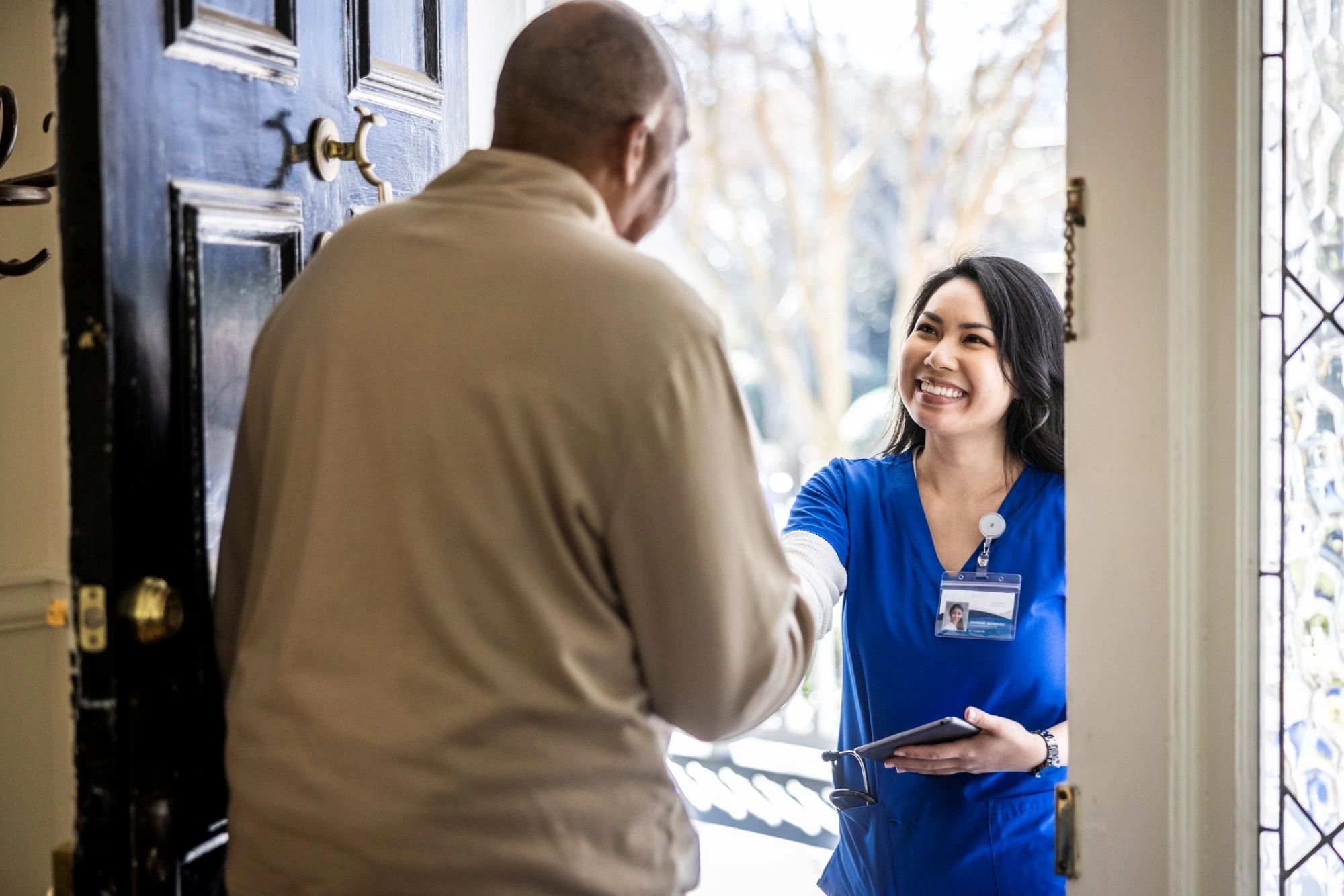
Non-medical in home support services provide an opportunity for frail
or ailing people to stay in thier home and perhaps maintain a more independent
lifestyle than a group home might offer.
Agencies can provide experienced caregivers who can assist these seniors
in a number of ways. Reputable agencies are bonded and insured and their
employees are covered by workers compensation and are regularly supervised.
Caregivers may work for a client a few hours per day or 24 hours seven
days a week. They prepare meals, do housekeeping, medication reminders,
run errands, manage incontinence, give baths and help clients transfer.
They also provide valuable companionship and encourage clients to exercise
and participate in activities. They are a help when a caregiver lives
at a distance, or with the frail senior, and just cannot be do all the
services necessary.
Non-medical homemaker services are often confused with licensed home
healthcare agencies. Some of these agencies also offer non-medical care,
but generally they offer nursing types of services on an intermittent
short-term basis. The client usually has a medical need that requires
the expertise of a RN, physical therapist or some other medical specialty.
In home supportive companies often work hand in hand with home healthcare
companies to help their clients.
In home support services range range from $13 to $20 dollars per hour
and $140 to $200 dollars for 24-hour care. Long term care insurance policies
can be helpful in meeting some of this cost . People who cannot afford
this cost may hire people privately for less money. However, they are
taking a risk and will have to manage these caregivers with no professional
assistance. However, reality sometimes dictates that this is the only
viable choice.
Whether you hire an agency to send you a helper or hire one directly
- read on:
Interview the candidate and/or the agency.
Inquire if there is a charge for the interview.
Get 3 work references for the candidate.
Get client references for the agency.
Is the care provider or agency bonded.
Obtain the Department of Motor Vehicle print out from their driver's
license.
Do a Felony Background Check or know that the agency has conducted
one. An Investigating Service will do this for a small fee.
Ask for proof of provider (or agency) worker's compensation insurance.
Ask for proof of care provider (or agency) full professional liability
insurance.
If the care provider is unable to work one day, will the care provider
(or agency) provide a substitute care provider?
Among other questions, ask:
How many years have you been in home care?
What were your duties for your last 2 patients?
What is your favorite duty while taking care of a patient?
What is your least favorite duty?
On a scale of 1-10, 10 being best,
how do you rate your:
Cooking skills?
Housekeeping skills?
Personal care?
Ability to following directions?
Flexibility?
Ability to work with other family members visiting or living
in the homE
Remodeling Directory
- Your one-stop destination for anything you can think about remodeling.
This Remodeling Directory is designed to help its users find the remodeling
information, articles, source, companies, products and services.
CCRCs, Congregate,
Independent Living and Assisted
Living offer opportunities they refer to as "Ageing in Place" after
one relocates to their community, since they offer levels of increasing
care, although most do not include nursing home level care within their
communities. Continuing Care Retirement Communities
(CCRCs) also offer the opportunity to "age in place" once you have
relocated to their community with a guarantee to that effect.
We welcome inquiries from providers of services and products who
wish to join seniorrresource.com