Hearing Loss: What to Know and What to Do
I never really thought much about hearing loss—until I started noticing that my husband was asking people to repeat themselves frequently, turning the TV volume louder, and engaging less in social conversations. He’s in his 40s, so it felt too soon for hearing problems to arise. Sadly, a trip to see his doctor helped us to understand that it isn’t true.
Hearing loss is about much more than simply struggling to hear conversations; it can impact relationships and mental health, and even cause people to feel isolated. The good news? The early diagnosis of hearing loss signs offers us plenty of opportunities to improve our hearing and protect it from further decline. Whether it’s noise exposure, aging, or underlying health issues, there are many reasons to acknowledge problems early and take proactive steps to address hearing health and hearing loss.
Understanding Hearing Loss
As it turns out, hearing loss is more common than we realize. Research into the severity of hearing loss in the US uncovered that an estimated 25.4 million, 10.7 million, 1.8 million, and 0.4 million US residents aged 12 years or older, respectively, have mild, moderate, severe, and profound better-ear hearing loss.
With numbers like these, protecting our hearing health is essential. An important first step is understanding what hearing loss is. It’s defined as the partial or complete inability to hear sounds in one or both ears. Hearing loss severity ranges from mild to profound. Some people experience it gradually, and others suddenly.
There are three main types of hearing loss:
Conductive Hearing Loss (CHL)
This occurs when sound waves cannot properly pass through the outer or middle ear. The cause can be a blockage or structural issues in the ear canal. CHL might stem from:
- An ear infection
- Severe earwax buildup
- Fluid in the middle ear, or
- Damage from an accident or injury to the eardrum or ear bones.
This type of hearing loss is often temporary. If you catch it early, it can be treated and potentially reversed through the use of medications or surgery.
Sensorineural Hearing Loss (SNHL)
This is hearing loss that results from damage to the inner ear (cochlea) or the auditory nerve. Common causes include:
- Aging
- Prolonged exposure to loud noise through work or recreational events like concerts
- Genetic factors, or
- Conditions like Meniere’s disease.
Unlike conductive hearing loss, SNHL usually cannot be reversed. However, quality of life can be improved through the use of small and comfortable hearing aids or cochlear implants.
Mixed Hearing Loss
Mixed hearing loss is exactly what it says it is: a mixture of conductive and sensorineural hearing loss. This means there is damage in both the outer/middle ear and the inner ear or auditory nerve. A senior experiencing age-related hearing loss (sensorineural) who also has an excessive buildup of earwax (conductive) may experience mixed hearing loss. Typical medical interventions involve both the use of hearing aids and addressing the underlying problem. In this case, that would mean cleaning out the earwax.
Medications and Hearing Loss
The use of certain medications can cause either CHL or SNHL. Very Well Health describes this as ototoxicity and classifies the medications in the following categories:
These medications may be associated with permanent hearing loss:
- Aminoglycoside antibiotics
- Platinum-based chemotherapy
These medications are more likely to cause temporary hearing loss.
- Loop diuretics
- Quinine
- Salicylates
- Vinca alkaloids
If your doctor assesses your hearing loss as being related to ototoxicity, they will evaluate the risks and benefits of the medication and determine if a suitable substitute is available or if discontinuing the medication is in your best interest. This is a decision that should only be made in consultation with a medical professional.
Signs and Symptoms of Hearing Loss
Now that we’ve discussed the types of hearing loss, you might be wondering what the signs are that could indicate you or a loved one is experiencing either CHL, SNHL, or mixed hearing loss. While only a healthcare provider can diagnose hearing loss, here are some symptoms to watch out for.
1. Difficulty understanding speech.
If you have a hard time understanding what people are saying, especially if there’s background noise or more than one person is talking at a time, it could indicate you’re experiencing hearing loss.
2. Tinnitus.
This is the sensation that you might sometimes experience, where you hear ringing, buzzing, phantom noises, or hissing in the ears when no external noises are present. You might notice this most at night or in a quiet moment. Age-related hearing loss or frequent exposure to very loud noises, like those on a construction site or at a rock concert, can cause tinnitus.
3. Frequently asking people to repeat themselves.
This was one of our first indicators that my husband was experiencing hearing loss. He constantly asked me and our children to repeat questions or sentences, and he would sometimes get annoyed when he didn’t understand what we said.
4. Challenges hearing high-pitched sounds.
People who experience hearing loss can have a tough time understanding children’s voices and women’s voices in conversation.
5. Avoiding social situations.
If you find yourself avoiding social situations because you feel uncomfortable or frustrated trying to communicate with people and understand them, it might be an indicator of hearing loss.
7. Feeling fatigued after listening.
When conversations and trying to listen to speeches or the television make you feel exhausted mentally, or even give you headaches, it may indicate that hearing loss is present.
If you or a loved one is experiencing any of these signs of hearing loss, it’s important to schedule a consultation with a medical professional.
Early treatment gives you the best chance to reverse hearing loss or get hearing aids and start to improve your quality of life. Avoiding treatment can lead to further hearing decline and mental health issues such as stress, anxiety, depression, or increased isolation due to avoiding social situations.
Diagnostic and Treatment Options

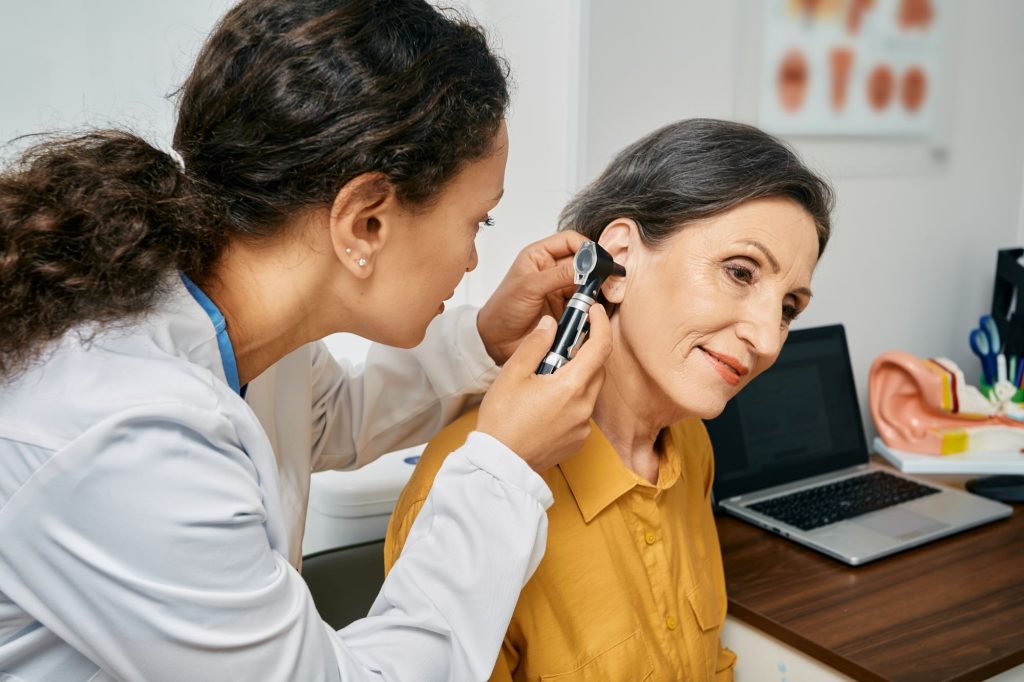
When we suspected my husband was experiencing hearing loss, our first thought was to call his doctor for an evaluation. His physician’s assessment included a visual inspection of my husband’s ear for any wax buildup (which was present) or other abnormalities (which were not).
His doctor also ordered blood tests to determine if an underlying autoimmune disorder might be in play. When these results came back normal, he referred my husband to an eye, ear, nose, and throat specialist for further evaluation.
The eye, ear, nose, and throat specialist conducted another, more thorough physical evaluation of the ear canal and used other specialized diagnostic tests, including:
Pure-Tone Audiometry
This measured my husband’s ability to hear sounds at different frequencies and volumes. He wore a pair of headphones while different tones played, and was asked to respond by raising a hand when he heard a sound. The sounds became increasingly difficult to hear as the test went on, indicating some hearing loss was present.
Speech Audiometry
Again, using headphones, my husband was assessed for how well he could hear and understand speech at different volume levels. We found that higher-pitched voices were more difficult for him to hear, such as a woman’s voice or a child’s voice.
Tympanometry
This test involved placing a small, air-tight probe in my husband’s ear, which changed the air pressure in his ear while playing a tone. It measured how the eardrum responded to changes in air pressure. The doctor told us that the goal was to detect any fluid build-up in the middle ear, eustachian tube dysfunction, or other conditions that were affecting his middle ear mobility and functioning.
Magnetic Resonance Imaging (MRI)
My husband’s hearing loss was significantly worse in his left ear than in his right. As a result, the specialist needed to determine if there were underlying neurological or structural causes. He determined that having imaging of the ears and head would provide him with the information to properly assess or rule out any concerns and ordered an MRI. In my husband’s case, the MRI results helped to rule out these possibilities.
After a thorough diagnosis, we discussed treatment options with the specialist. Ahead of this conversation, my husband and I conducted some research on our own to understand available options and feel prepared for the conversation. These are some of the options we found:
1. Medical Treatments for Hearing
- Earwax Removal: A doctor can often remove excessive earwax using suction, irrigation, or special tools. This procedure may need to be repeated at certain intervals if ear wax buildup is the cause of hearing loss.
- Medications (Antibiotics or Antifungals): If an ear infection or fluid buildup causes hearing loss, medications can help clear any infection and potentially restore hearing. Antibiotics and antifungals can be a stand-alone treatment or used in conjunction with surgery or hearing aids.
2. Surgical Treatments for Hearing
- Tympanoplasty (Eardrum Repair Surgery): A perforated eardrum can sometimes be repaired with surgery.
- Ossiculoplasty (Middle Ear Surgery): If the bones of the middle ear (ossicles) are damaged, prosthetic implants might be inserted to replace them.
- Pressure Equalization (PE) Tubes: For individuals who suffer from chronic fluid buildup in the middle ear, tubes can be inserted to drain the fluid. This often relieves discomfort, reduces future ear infections, and can improve hearing.
3. Hearing Aids
When a doctor determines that hearing loss cannot be reversed, hearing aids help to improve hearing and quality of life. There are several different options for individuals who need hearing aids.
- Behind-the-Ear Hearing Aids: These small devices sit behind the ear, are lightweight, and are the most obvious to the naked eye. They are suitable for mild to profound hearing loss.
- In-the-Ear Hearing Aids: Custom-molded hearing aids that precisely fit the ear. These often work well for mild to severe hearing loss.
- Completely-in-Canal Hearing Aids: These are the smallest and most discreet hearing aids. They are custom-sized and ideal for mild to moderate hearing loss.
4. Cochlear Implants
A cochlear implant may be recommended when hearing loss is severe or there is inner ear damage that hearing aids cannot address. This device is surgically implanted under the skin, behind the ear. It bypasses damaged hair cells in the cochlea and directly stimulates the auditory nerve.
My husband’s doctor ended up removing excess wax from my husband’s ears and recommending hearing aids due to the nature of his hearing loss and the fact that it is considered irreversible. After discussing costs, comfort, and the severity of his hearing loss, we determined behind-the-ear hearing aids to be the best option for his situation.
Lifestyle and Communication Strategies

By using his hearing aids, my husband has found living with hearing loss to be less challenging than he expected. He’s also discovered that small adjustments make a big difference in improving the quality of his life.
When communicating, he does his best to face the person. He will ask someone to slow down or speak clearly but also explain that it isn’t necessary to speak louder. If the environment is noisy, he tries to find a well-lit spot in the room to make it easier to see facial expressions and watch the speaker’s lips.
He doesn’t need them at this point, but his doctor has explained the benefits of using captioned phone services and assistive listening devices in the future, should his hearing loss progress with age.
Even though he’s already experiencing hearing loss, he recognizes that it’s never too late to protect his hearing. We wear earplugs at concerts and avoid prolonged exposure to loud noises, when possible. He’s now visiting his doctor every six months for a hearing check-up, and I’ve made it a point to ask my doctor about hearing, too, so I can catch any hearing loss in the earliest stage possible. Simple lifestyle tweaks, like managing stress, exercising, and eating a balanced diet, also support hearing, health, and wellness.
Support and Resources for Individuals with Hearing Loss
Living with hearing loss does not have to feel overwhelming or isolating. There are many resources and support systems available to help.
Connecting with others with shared experiences—whether locally at in-person support groups or in online communities—is impactful. These are ideal spaces to share stories, learn strategies from people who are experiencing what you’re experiencing, and express challenges or frustrations.
Groups like the Hearing Loss Association of America (HLAA) and The American Speech-Language-Hearing Association (ASHA) support individuals with hearing loss. These groups have chapters across the country and offer online support and educational resources with easy access to information. They can also connect you with networking opportunities through other groups in your local community.
Medical professionals are an essential part of your support network for anyone experiencing hearing loss. Along with your primary doctor, audiologists and hearing specialists are valuable connections to establish. They provide guidance on assistive technology, hearing aids, and communication strategies to make daily life easier and help monitor for progressions or improvements throughout your hearing health journey.
Loo for accessibility services like captioned telephones, hearing loops, and speech-to-text apps in public spaces, including your workspace. Using these devices makes communication more seamless and can improve your comfort level while out in public.
Should you need them, legal protections exist, such as the Americans with Disabilities Act (ADA). This is the reason why accessibility services are available in public spaces, and it ensures that equal access is available for anyone experiencing hearing loss.
Prevention of Hearing Loss
Even though my husband is already experiencing hearing loss, he recognizes that it’s never too late to protect his hearing. We wear earplugs at concerts and avoid prolonged exposure to loud noises, when possible. He’s now visiting his doctor every six months for a hearing check-up, and I’ve made it a point to ask my doctor about hearing, too, so I can catch any hearing loss in the earliest stage possible. Early diagnosis and intervention are key to maintaining hearing health and minimizing hearing loss, should an issue arise.
Simple lifestyle tweaks, like managing stress, exercising, and eating a balanced diet, also support hearing, health, and wellness. We also try to avoid toxic substances, such as heavy metals, carbon monoxide, and pesticides. If we use paint solvents, we wear protective gloves, use them in a well-ventilated area, and immediately wash our hands. These environmental factors can damage hearing, so avoiding them or minimizing our exposure helps to keep us safer and healthier.
Takeaway

Navigating hearing loss alongside my husband has been an eye-opening journey, and it’s taught me just how important it is to prioritize hearing health and recognize how connected it is to quality of life. From understanding early signs of hearing loss to finding the right support and technology, managing hearing health means being proactive and informed. Simple changes, using communication strategies, protecting our ears at concerts, and developing a trusted relationship with our doctor for hearing check-ups, are key.
If you or someone you love is having a difficult time hearing conversations or finding that life is a little less enjoyable, don’t ignore potential signs of hearing loss. Seek medical help for a thorough assessment and explore your lifestyle, medical, and surgical options. Embrace the tools that can help you enjoy life more in the world around you. Hearing is essential to quality of life, and by taking care of it now, it’s possible to enjoy more meaningful conversations, deeper connections, and a happier, healthier you for years to come.
For more great articles like this one, visit our Health & Wellness Blog!

Popular Articles About Hearing
Originally published April 11, 2025
Author(s):