What Does Medicare Part B NOT Cover During an Emergency Room Visit?

Dear Toni,
I have been told that Medicare does not cover drugs when you are in an emergency room. My mother went to the hospital from the ER for 2 days, and because it was considered “under observation,” we are now fighting the hospital because they say her drugs were not covered during her stay. She has a Part D plan, but the hospital pharmacy claim is filed out of network. She now has to pay a higher amount because the hospital pharmacy is not in the Part D plan’s “preferred” network.
I am helping my mom file this claim and do not know what to do. Please explain what her options are.
Thanks,
Clyde from Lake Charles, LA
Hello Clyde,
Medicare Part B (medical insurance) covers medical care you receive in a hospital outpatient setting, like an emergency room, observation unit, outpatient surgery center, or pain clinic. Part B covers IV (intravenous infusion) drugs but not prescriptions given orally. Had your mother been classified as “inpatient care,” her prescriptions would have been paid for by her Medicare Part A (hospital insurance). Because her ER hospital stay was classified as “under observation,” she will have to pay for the drugs administered unless she is enrolled in a Medicare Prescription Drug Part D plan.
This is why enrolling in a Medicare Part D drug plan is so important!

When you are having a medical issue in the emergency room, you may need your self-administered drugs to be covered through your Part D plan. Self-administered drugs are what you would normally take on your own or over-the-counter type drugs. Part B does NOT pay for these types of drugs, but a Medicare Part D Prescription Drug plan can.
If you do not have a Medicare Part D drug plan while in a Part B “under observation,” hospital outpatient setting, or emergency room, then you will have to pay the drug cost out of your pocket!
During a Toni Says Medicare consultation with Americans enrolling in Medicare for the first time, we stress why they need to enroll in a Part D drug plan, even if they do not currently take prescriptions. The Toni Says team also shows them how to enroll in the least expensive Part D plan.
No one knows what the future holds, but Medicare is doing everything to control how the government spends our Medicare dollars. New Medicare rules are popping up each year to make sure Medicare dollars are being spent wisely.
For readers on Medicare who have missed their Part D enrollment deadline, I would recommend that they enroll in a Part D plan during Medicare’s open enrollment period from October 15th to December 7th to keep from receiving further Part D penalties.
Clyde, I have good news for how you can help your mother. Here is what to do when you receive a hospital bill for prescriptions not covered by Medicare Part B in a hospital outpatient setting:
- Most hospital pharmacies do not participate in Medicare Part D; you may need to pay upfront and submit the claim to your Medicare Part D drug plan for a refund.
- Follow the instructions on how to submit an out-of-network claim.
- You may need to send certain information, like emergency room bills that show what self-administered drugs you were given.
- You might need to explain the reason for the hospital visit.
- Keep copies of receipts and paperwork you send to your Part D plan.
How to Choose a Part D Plan
Choosing a Medicare Part D plan using Medicare.gov‘s online tools can be a helpful and efficient way to find the right coverage for your prescription drug needs.
Start by gathering your information.
- Make a list of your current prescription drugs, including dosages and frequencies.
- Note any preferred pharmacies or providers you would like to use.
- Consider your budget and desired level of coverage.
Visit the Medicare Plan Finder on Medicare.gov.
- Go to www.medicare.gov.
- In the navigation, scroll over “Health & Drug Plans.”
- Click “Drug Coverage (Part D)
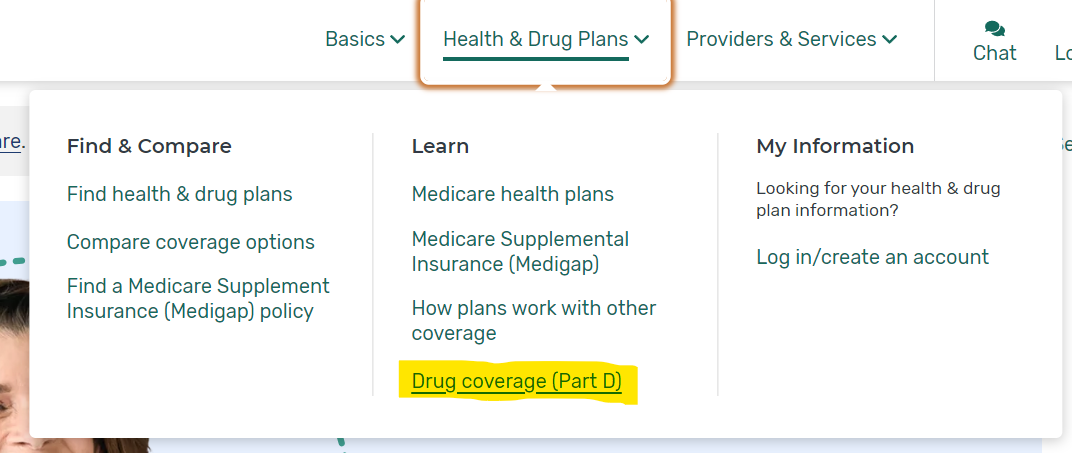
- Enter your ZIP code and follow the prompts to provide additional personal information.
Enter your prescription drugs.
- On the Medicare Plan Finder, select the option to enter your medications.
- Type in the names of your prescription drugs and follow the prompts to provide details such as dosages and frequencies.
- If you’re unsure about a specific medication, you can skip it or consult with your healthcare provider for accurate information.
Compare available plans.
- After entering your medications, the Medicare Plan Finder will generate a list of available Part D plans in your area.
- Use the filtering options to narrow down the results based on factors like premium costs, deductible amounts, and copayments.
- Pay attention to the estimated annual costs and the coverage details provided for each plan.
Review plan details and make your selection.
- Click on individual plan options to review the specific details, benefits, and restrictions.
- Consider factors such as formulary coverage (ensuring your medications are covered), preferred pharmacies, and any utilization management requirements.
- Compare the total estimated annual costs, including premiums, deductibles, copayments, and coinsurance, to find a plan that aligns with your budget and coverage needs.
Readers, the Medicare.gov website is unique and offers those exploring Medicare (whether turning 65, past 65, and retiring or laid off) options for finding the correct Medicare and Part D plan for your current needs!

More Medicare Questions? Start Here!
Image Credit: JazzIRT @ Getty Images | https://www.shutterstock.com/g/9dreamstudio

Popular Articles About Medicare
Originally published March 06, 2025
Author(s):