When & How Federal Employees Should Enroll in Medicare
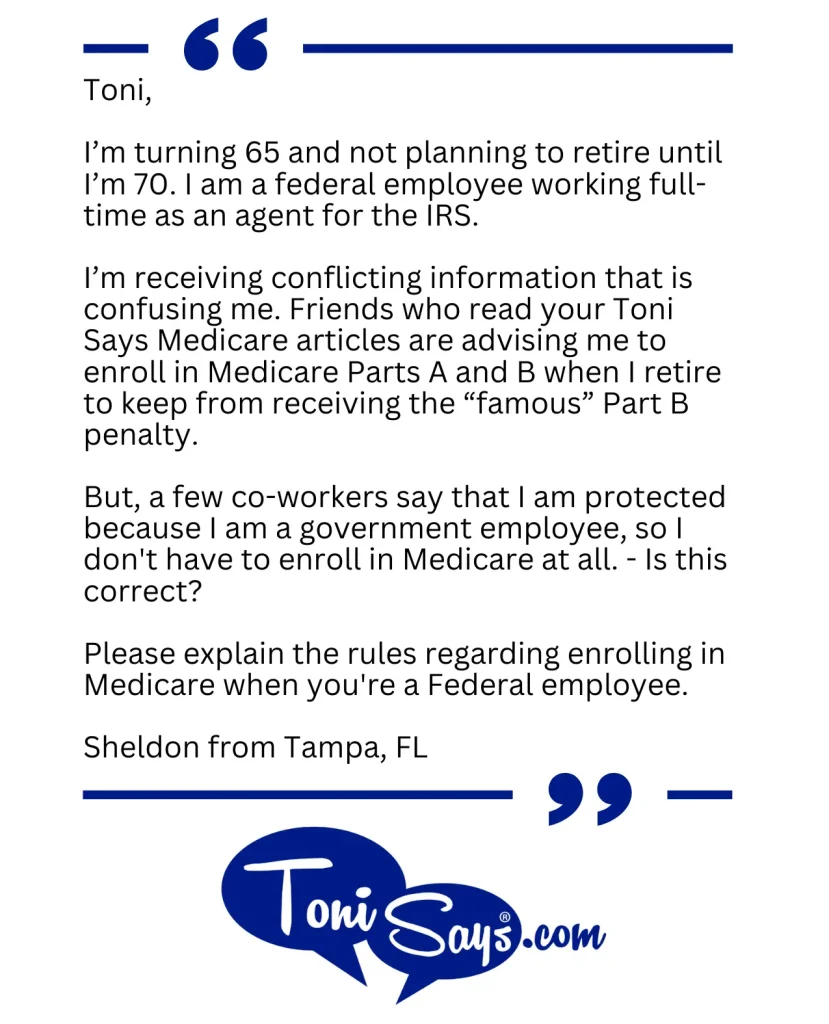
What are the rules for enrolling in Medicare when you’re a full-time federal employee?

Your friends are correct!! You should enroll in Medicare Parts A and B when you retire.
The rules for enrolling in Medicare are consistent for both federal employees and the general population. The requirement for federal employees to enroll in both Medicare Parts A and B was implemented a few years ago. Specifically, it’s part of the Postal Service Reform Act, mandating that postal workers are required to enroll in Medicare Parts A and B. Per the Federal Register: “Subject to limited exceptions, Postal Service annuitants who retire and become entitled to Medicare Part A after January 1, 2025, and their family members who are entitled to Medicare Part A will be required to enroll in Medicare Part B as a condition of eligibility to enroll in the PSHB Program.”
When an active federal employee covered by Federal Employees Health Benefits (FEHB) has a health need, the FEHB plan is the primary payer. Upon retirement (as an annuitant) and enrollment in Medicare Parts A and B with an FEHB retiree plan, Medicare becomes the primary coverage while FEHB serves as secondary coverage.
For federal employees with FEHB coverage who work past age 65, enrolling in Medicare Part B at 65 is not mandatory as long as they remain in federal service. This does not apply to postal workers, who need to maintain their Part B Coverage to keep their PSHB (Postal Service Health Benefits), as of January 1st, 2025. Other federal workers’ FEHB plan continues as the primary coverage. Upon retirement (or their spouse’s retirement if the spouse provides FEHB coverage), they have a Special Enrollment Period (SEP) to enroll in Part B without penalties.
Let’s break down Medicare’s three enrollment periods for federal employees with FEHB benefits:
Initial Enrollment Period (IEP)
If a federal employee retires before turning 65 and maintains FEHB health insurance into retirement, they can enroll in Medicare during the Initial Enrollment Period (IEP). Medicare’s IEP spans a 7-month period: starting three months before turning 65, the birthday month, and three months after turning 65. It’s important to note that everyone—including federal workers—is required to pay a premium for Part B coverage. If you do decide to enroll in Medicare, your benefits will coordinate. Enrolling in Medicare does NOT reduce your FEHB premiums.
Special Enrollment Period (SEP)
When a federal employee (or their spouse) past age 65 delayed enrolling in Medicare Part B due to ongoing service with FEHB benefits, they have an 8-month window to sign up for Part B without incurring a penalty. To enroll correctly, the retiree must submit CMS-L564 (Request for Employment Information) from the human resources office and CMS-40B (Application for Part B) at the local Social Security office.
General Enrollment Period (GEP)
Occurring from January 1st to March 31st each year, the GEP is the sole opportunity for a retiree (or a retiree’s spouse) over 65 who never enrolled in Medicare Part B to do so. Enrolling during this period will result in a Medicare Part B penalty for previous non-enrollment.
These three enrollment periods are the same for Americans who do not have the benefits that federal employees have.
It will always be to the federal retiree’s advantage to keep the FEHB plan due to the excellent coverage it provides. And the FEHB plan is considered “creditable” Medicare Part D coverage. So, retirees who want to enroll in Part D at a later date can do so without receiving a Part D penalty.
What About Medicare’s Open Enrollment?

Open enrollment occurs from October 15th to December 7th every year. It’s for anyone already enrolled in Medicare to make changes to their coverage. This includes switching between Original Medicare and a Medicare Advantage plan, or changing Medicare Advantage plans or Part D prescription drug plans. Coverage for these changes typically starts the following January 1st.
More Helpful Medicare Resources
Remember, when it comes to Medicare, what you don’t know WILL hurt you! Here are a few helpful Medicare resources for retirees and their families:
- Medicare.gov
- Learn about Medicare’s coverage of doctor and other health care provider services.
- Find information on Medicare health plans.
- Medicare and You Handbook 2025
- Toni Says
Check out our Medicare Blog right here on Senior Resource!


Image Credit: Shutterstock

Popular Articles About Medicare
Originally published April 17, 2025
Author(s):